The Complete Peptide Reconstitution Guide
Your vial is in milligrams. Your syringe is in units. Here is the arithmetic that joins them up, and a table so you only have to do it once.
The Gap Nobody Warns You About
Your vial says 10 mg. Your protocol says 500 mcg. Your syringe is marked from 0 to 100 and mentions neither.
That gap is where nearly every dosing mistake happens. And these mistakes are not small ones — misplace a decimal point and you have taken ten times what you meant to.
The good news is that it is three lines of arithmetic, you only do it once per vial, and after that you are reading a number off a syringe like everybody else.
The Three Steps
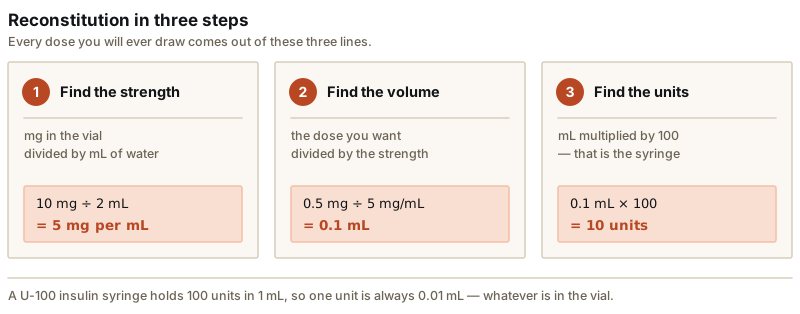
One — how strong did you make it? Divide the milligrams in the vial by the millilitres of water you put in. A 10 mg vial with 2 mL of water is 5 mg per mL. That number is now a property of that vial, and it stays true until the vial is empty.
Two — how much liquid is your dose? Divide the dose you want by the strength. Half a milligram out of a 5 mg/mL vial is 0.1 mL.
Three — turn that into units. Multiply by 100. That is 10 units.
What A "Unit" Actually Is
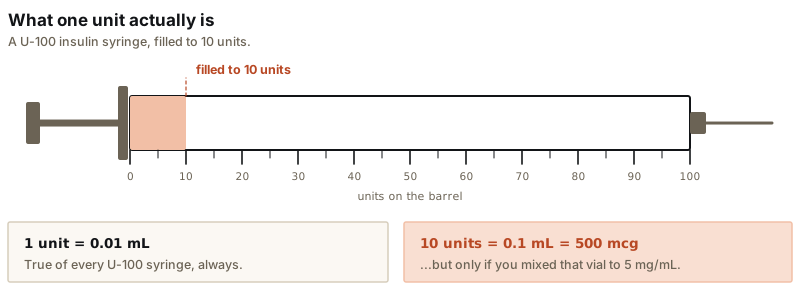
An insulin syringe is not marked in millilitres. It is marked in units, and on a U-100 syringe — the standard, and almost certainly the one you are holding — 100 units is 1 mL. So one unit is 0.01 mL, and that never changes no matter what is in the barrel.
Here is the part worth reading twice: a unit is an amount of liquid, not an amount of peptide. Ten units drawn from a strong vial and ten units drawn from a weak one look identical and are completely different doses. The syringe has no idea what you dissolved.
This is exactly why "just take 10 units" is useless advice from a stranger on a forum. Ten units of *their* vial is not ten units of yours.
The Table That Saves You The Maths
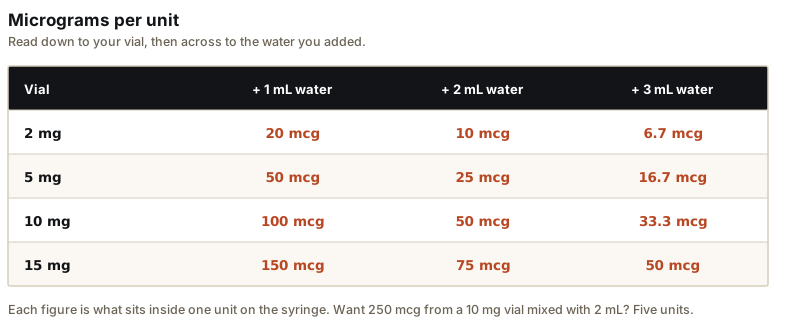
Find your vial down the left, the water you added across the top, and you have how many micrograms are sitting in a single unit. From there any dose is one division.
Want 250 mcg from a 10 mg vial you mixed with 2 mL? That row says 50 mcg per unit, so you need five units.
How Much Water Should You Add?
There is no correct answer here, only a trade-off, and it is worth understanding rather than copying.
More water makes a weaker solution, so your dose takes up more units on the syringe. That is easier to measure accurately — the difference between 20 and 22 units is easy to see, and easy to hit.
Less water makes a stronger solution and fewer units. Fine for large doses, bad for small ones, because now a tiny slip on the plunger is a big change in dose.
A decent rule of thumb: aim for your usual dose to land somewhere between 10 and 30 units. If your maths puts you at 2 units, you have used too little water and you are trying to measure something the syringe cannot really resolve.
Actually Mixing It
Let both vials sit until they are at room temperature. Wipe both rubber stoppers with an alcohol swab and let them dry.
Draw up your Bacteriostatic Water, then put the needle in at an angle so the water runs down the inside wall of the vial. Do not fire it straight down onto the powder. Peptides are fragile and there is no reason to be rough with them.
Then leave it alone. Do not shake it. Swirl it gently if you must, but most peptides dissolve on their own within a minute or two. If it is still cloudy after ten minutes, or there is anything floating in it, something has gone wrong and you should not use it.
Storing What You Have Mixed
Bacteriostatic water contains a small amount of benzyl alcohol — that is the "bacteriostatic" part, and it is what stops bacteria growing in a vial you are going to puncture repeatedly. Sterile water has none of that, which makes it a single-use proposition.
Once mixed, the vial goes in the fridge, not the freezer. The commonly quoted working life is around 28 days, which comes from how long the preservative is relied on rather than from a study of your specific peptide.
The Mistakes That Actually Happen
Using the wrong syringe. A 0.3 mL insulin syringe holds 30 units, not 100. If you read it as though the far end were 100, everything you draw is wrong.
Confusing mg and mcg. A milligram is a thousand micrograms. This is the decimal slip that matters most.
Assuming somebody else's units. Covered above, and it bears repeating, because it is the single most common way people end up dosing something completely different from what they intended.
Redoing the maths every time. You do not need to. Work it out once when you mix the vial, write the units on the label with a marker, and stop thinking about it.
- reconstitution
- dosing
- guide
- beginners
Written for reference. Everything Siam Labs sells is supplied for laboratory research only — not for human or veterinary use.