Retatrutide vs Tirzepatide: What The Trials Actually Say
One pulls two levers, the other pulls three. The trial numbers are far apart — but they came from different trials, and that turns out to matter.
Same Family, Different Number Of Levers
Tirzepatide and Retatrutide come from the same line of thinking: copy the gut hormones that tell your body it has eaten, and hold that signal on.
The difference is how many of those signals each one imitates.
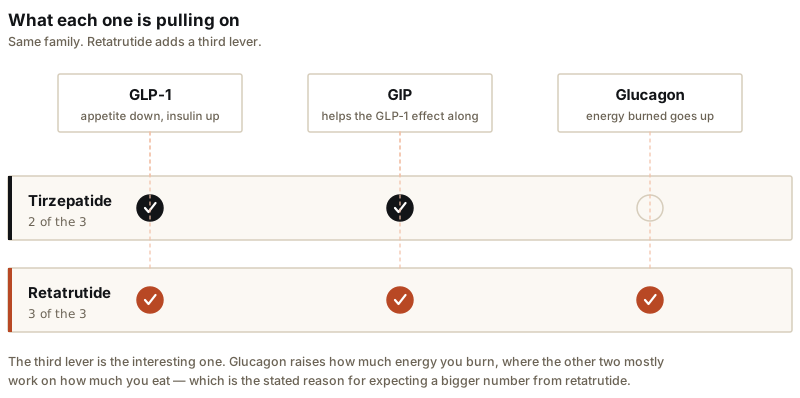
Tirzepatide works on two — GLP-1 and GIP. Between them these mostly govern appetite and insulin: you feel full sooner, you stay full longer, and your blood sugar behaves better.
Retatrutide adds a third: glucagon. This is the interesting one, because glucagon is not really an appetite hormone. It affects how much energy your body burns. So where the first two work on the intake side of the equation, the third one leans on the output side.
That is the whole design argument for a triple agonist, and the trial numbers are consistent with it.
What The Trials Found
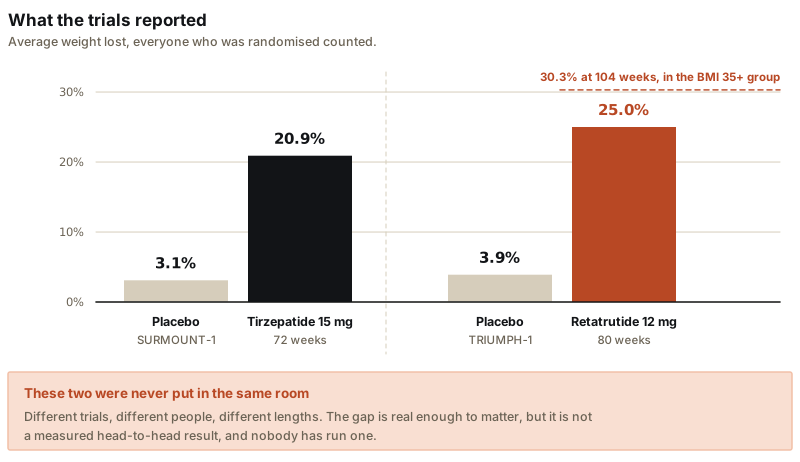
Tirzepatide, SURMOUNT-1. Adults with obesity, no diabetes, 72 weeks. The 15 mg group lost an average of 20.9% of their body weight; placebo lost 3.1%. That was a startling result at the time and it is why tirzepatide is where it is today.
Retatrutide, TRIUMPH-1. The phase 3 result reported in 2026, at 80 weeks. The 12 mg group averaged 25.0%, against 3.9% on placebo. In a pre-planned extension out to 104 weeks, the 12 mg group in the higher-BMI arm reached 30.3% — and notably the curve had not flattened out by then.
For context, an earlier phase 2 trial had put retatrutide at 24.2% over 48 weeks, so the phase 3 result held up rather than shrinking, which is not always how this goes.
Why You Cannot Just Subtract One From The Other
Here is where most comparisons you will read go wrong.
These two drugs have never been tested against each other. Not once. Everything above is two separate trials, run years apart, with different people in them, for different lengths of time — 72 weeks against 80. Retatrutide got an extra two months to accumulate its number.
There is also a subtlety in how the results get counted. Trials report weight loss two ways: one figure counts everybody who was randomised, including people who quit; the other estimates what happens if you actually stay on the drug. The second is always the bigger number. The figures above are the first kind for both drugs, which is the fair way round — but if you see 22.5% for tirzepatide or 28.3% for retatrutide quoted elsewhere, that is the other measure, and it is not wrong, just a different question.
The honest summary: retatrutide looks stronger, the gap is probably real, and nobody has measured it directly.
The Side Effects Scale Too
You do not get the bigger number for free. In TRIUMPH-1, nausea affected around 42% of the top-dose group, with diarrhoea, constipation and vomiting all more common as the dose went up. That is the same pattern as every drug in this class, and it is dose-dependent, which is why titration schedules exist.
Adding glucagon to the mix also means an increase in heart rate has been observed, and it is one of the things regulators will be looking at closely.
The Thing That Actually Separates Them Right Now
Tirzepatide has been through the regulatory process and is a licensed medicine in many countries. Retatrutide has not. As of now it remains investigational — the phase 3 programme has read out positively, but it has not completed its journey.
That is not a small distinction, and it is worth sitting with rather than skipping past. One of these has an approved label, a known manufacturing chain, and a body of post-market safety data. The other has extremely promising trial results and none of the rest of it yet.
- Retatrutide
- Tirzepatide
- GLP-1
- trials
Written for reference. Everything Siam Labs sells is supplied for laboratory research only — not for human or veterinary use.