BPC-157 vs TB-500: Two Different Jobs
They get sold together and talked about as if they were interchangeable. In the research they are doing quite different things — which is the actual argument for running both.
Two Peptides With The Same Job Title
Ask around and you will hear BPC-157 and TB-500 described the same way: healing peptides, good for injuries, take them together. All of which is roughly true and explains nothing.
They are not two versions of the same idea. In the published work they are pulling on completely different mechanisms, and once you see what each one is doing, the reason people run both stops being folklore and starts making sense.
BPC-157: Building The Supply Line
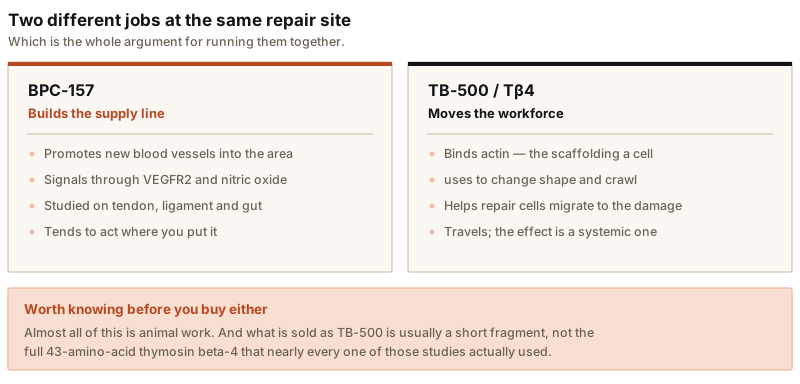
BPC-157 is a short chain derived from a protein found in human gastric juice. The research on it keeps circling back to one theme — blood supply.
In animal studies it promotes the growth of new blood vessels into damaged tissue, apparently by way of VEGFR2 signalling and nitric oxide. That matters because the classic problem with tendon and ligament injuries is that these tissues have a poor blood supply to begin with. Not much gets in, so not much repair happens, and what does happen takes months.
The other consistent finding is that it tends to act where you put it. Much of the work involves the gut, tendon, and ligament, with the effect showing up locally rather than everywhere at once.
TB-500: Moving The Workforce
TB-500 is the version sold of thymosin beta-4, a protein your body already makes in quantity at wound sites.
Its mechanism is a different kind of thing entirely. Thymosin beta-4 binds actin — the internal scaffolding a cell uses to change shape and crawl. Cells that are going to repair damage have to physically travel to the damage first, and actin is how they do it.
So where BPC-157 reads as *improving conditions at the site*, TB-500 reads as *helping the repair crew get there*. And unlike BPC-157 it appears to travel: the effect described in the literature is a systemic one rather than something confined to where the needle went.
So Why Stack Them?
Put plainly: a better supply line and a faster workforce are not the same improvement, and neither substitutes for the other.
That is the whole argument, and it is a reasonable one. It is also worth being clear that it is a mechanistic argument — it makes sense on paper. There is no trial showing that the pair beats either one alone in a human being. Our Wolverine Stack exists because this is the combination people ask for, not because someone has proven it is better.
The Part That Usually Gets Left Out
Two things you should know before spending money on either.
Almost all of this is animal work. Rats, mostly. That is not nothing — mechanisms often carry across — but rodent tendon healing is not a clinical result in a person, and anybody presenting it as one is overselling.
What is sold as TB-500 is often not what was studied. Natural thymosin beta-4 is a 43-amino-acid protein, and it is the molecule in essentially all of the wound and cardiac research. TB-500 is typically sold as a shorter synthetic piece built around the actin-binding part of that sequence. The reasoning is that the active bit is the active bit — which may well be right, but a fragment is not automatically the same drug, and the studies people cite were not run on it.
That is a genuine gap, and it is not one the vendor selling you the vial can close.
What Nobody Can Tell You
There is no established human dose for either compound. Dosing that circulates online is extrapolated from animal studies and from what other people say they did — it is convention, not evidence.
Same for how long to run them. The animal work uses short courses around an acute injury. Nobody has published what happens if you take either one continuously for a year.
If you are going to use them, the sensible framing is to treat it as an experiment you are running on yourself with incomplete information, rather than a protocol somebody validated. Everything above is what the research reports, not advice about your body — and a persistent injury deserves an actual diagnosis before it deserves a peptide.
- BPC-157
- TB-500
- recovery
- stacking
Written for reference. Everything Siam Labs sells is supplied for laboratory research only — not for human or veterinary use.